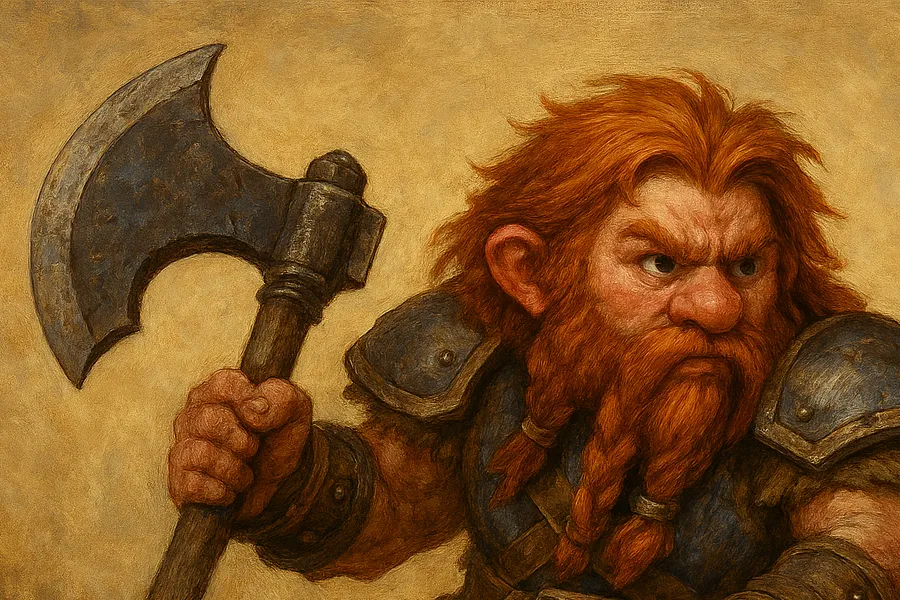
Dwarven Barbarian DnD Background story
The tale of how a hot-blooded dwarven warrior lost everything in a single night—and why he now walks the adventurer’s path.
Durgan
Durgan Winternut is a young dwarf who grew up in Ironmaster, a mining community in the mountains where most families either work the mines, the forges, or support both.
His father, Dolgrin Winternut, was a respected weaponsmith known for his sturdy battleaxes and warhammers. His mother, Kathra, was managing the household and keeping the family’s accounts. He had two siblings.
Brunhile, his older sister, married into another smithing family in the village. And Torvan, his younger brother (around 15 in dwarven years), who was apprenticing with his father and was showing real talent at forge.
Durgan was working alongside his father in the smithy, mostly handling the heavy work - stoking the forge, working the bellows, hammering out rough shapes. He had the strength for it but lacked the patience for detail work. His father hoped he’d develop that patience with time.
But he was also part of the village militia, training regularly with the warriors who defended against raids from orcs or the other threats from the nearby mountains. This is where his battle insticts thrived - he was one of the strongest fighters in his age group, if undisciplined.
He was 50 years old (young adult for a dwarf, equivalent to early 20s for a human) but old enough to be capable but still hot-headed and impulsive. Bar fights was not something unheard of for young Durgal. His parents constantly lectured him about controlling his temper. The community tolerated it because his was yound and strong, and when properly directed, that fury made him a fierce defender.
Life was predictable, hard work but good—until his hot blood got him in trouble one time too many.
The Blackstones
Grimbold Blackstone was around 70 years old (middle-aged dwarf - late 30s to early 40s in human lifespan). He’d served the militia for about 30 years, participating in several successful defenses against orc raids and goblin intrusions. His combat record was legitimate, though not as decorated as he often implied when drinking.
Grimbold had a mean streak when drunk and enjoyed reminding younger dwarves of their “place”. He was the type to use his family’s position to talk down to others, especially those from working families like the Winternunts. Sober, he was more reserved—competent enough at his duties but uninspiring as a leader.
The Blackstones was one of the more prominent families in the village, though not the wealthiest or most powerful.
Thorgrim Blackstone (Grimbold’s father) was owning and operating one of the three major mining operations in the village. The Blackstone mines produced decent iron ore and have been in the family for generations. Thorgrim was a shrewd businessman, respected but not particularly well-liked — known for driving hard bargains and paying his workers fairly but not generously.
Grimbold’s mother died years ago in a mining accident, which some say made both father and son more bitter.
Grimbold had a younger sister who married into a merchant family in a neighboring settlement, and a younger brother who was working in the family mines as a foreman.
The Blackstones had influence due to their wealth and the jobs they provided, but they were not beloved. They were the type of family that demands respect based on position rather than earning it through character. Thorgrim was sitting on the village council of elders, which gave him significant voice to village matters.
As the eldest son, Grimbold was expected to eventually take over the family mining business, but he preferred militia service — perhaps because it gave him status without the grinding responsibility of actually running the mines. His father tolerated this but made no secret of his disappointment.
Grimbold was about 20 years Durgan’s senior — a veteran of the militia. He was known as a solid warrior, though some whispered he was better at talking about his exploits than actually performing them. Still, he had respect due to his family’s position and his years of service.
He’d always looked down on Durgan, seeing him as an undisciplined young hothead who hadn’t earned his place among the warriors. There was an edge of jealousy too — he was stronger and faster than he’d ever been, and some of the younger militia members looked up to Durgan more than they did him.
The Stonehewn Hall tavern
The fateful events happened in the Stonehewn Hall tavern after a long day’s work. Durgan was drinking with some fellow militia members when Grimbold, already deep in his cups, started talking loudly at the next table.
He said Durgan’s father’s weapons were “peasant work” — functional but lacking the artistry of TRUE master smiths. Then he went further: he claimed the Winternut family had been cutting corners, using inferior ore to increase profits, and that half the militia was carrying substandard equipment because of Dolgrin’s greed.
It was a lie — a damned lie — and it struck at everything Durgan’s family stood for. His father’s honor, his family reputation, and his livelihood.
He confronted him immediately. Grimbold sneered and said if he didn’t like it, maybe he should try to teach him some manners — “if you’re not too busy learning how to actually swing a hammer properly.”
That’s when fists started flying.
It was brutal but brief. Durgan got the better of him—bloodied his nose, split his lip, left him with a black eye and bruised ribs. Others pulled them apart before it went too far. Grimbold spat blood and swore at Durgan, but seemed more embarrassed than seriously hurt.
He left the tavern under his own power, still cursing. Durgan stayed for one more drink to cool off, then went home.
Nobody saw Grimbold alive again.
A Murder in Cold Blood
The next morning the village guard dragged Durgan from his bed. Grimbold was found dead in an alley, skull caved in. A hammer with Winternut’s insignia carved on it was found near the body, covered in blood.
In the next days several dwarves had come forward claiming they saw Durgan following Grimbold after the fight. Durgan was imprisoned until the trial proceedings.
The Trial
The trial took place in the clan hall three days after the incident. The entire village seemed to be present - standing room only, tension thick in the air.
The council consisted of five respected dwarves who were handling disputes, major decisions, and justice in the village.
Barundar Stoneshield, the Head Elder, was an ancient dwarf, over 300 years old, who served as a warrior in his youth and now was leading the council. Fair-minded but stern, he valued evidence and tradition equally.
Thorgrim Blackstone, Grimbold’s father, and his presence on the council created an obvious conflict, but dwarven tradition allowed him to speak for his family’s grievance.
Elder Grimna Stoneforge, the village’s senior priestess of Moradin, was focusing on spiritual matters and the preservation of the clan honor. She seemed troubled throughout the proceedings.
Borin Deepdelver, represented the mining families and workers. Pratical and cautious, he was concerned with maintaining peace in the village.
Heldra Axeborn, the eldest of the militia commanders, a scarred veteran, knew both Durgan and Grimbold from training and service.
The evidence presented against Durgan was that a hammer matching the description of one from Winternut smithy was found near the body, covered in blood and hair. The hammer bore the Winternut maker’s mark.
Three witnesses (all Blackstone mine workers) who claimed they saw Durgan leaving the tavern shortly after Grimbold and heading in the same direction.
The public brawl earlier that evening - dozens witnessed Durgan’s rage and the beating he gave Grimbold with his fists.
Durgan was well known for his hot temper and previous altercations.
There were also several facts in Durgan’s defense.
Durgan was fighting with a greataxe, not a hammer - anyone in the militia could confirm this. Why would he suddenly use a hammer?
His father testified that several hammers bearing the Ironfoot mark had been sold or commissioned in recent months — it could have been any of them.
The hammer wasn’t one recognized as belonging to Winternut family’s current inventory, though it did bear their clan’s maker’s mark.
Durgan went straight home after the fight — his brother Torvan testified he heard him come in, though he couldn’t confirm the exact time.
Durgan had no memory of the witnesses who claimed to see him, and they couldn’t provide specific details about what he was wearing or doing.
Why would a warrior who carries a greataxe suddenly switch to an unfamiliar weapon, then leave it at the scene with his family’s mark on it?
During the trial, Heldra Axeborn emphasized this point strongly: “This dwarf fights with an axe. I’ve trained him myself. The weapon is wrong — any warrior would know this.” But the prosecution argued that he might have grabbed the first weapon at hand in a rage, or deliberately used a hammer to make it look less like his doing. She also pointed out other inconsistencies: Durgan was a warrior, if he’d wanted Grimbold dead, why do it so clumsily? The scene looked staged to her experienced eye, though she couldn’t prove it.
Thorgrim Blackstone demanded his execution, calling him a murderer who’d let his temper turn to killing. His grief seemed genuine, even if his righteousness felt performative.
Elder Grimna questioned the witnesses closely, clearly skeptical of their convenient testimony, but they held to their story.
Barundar Stoneshield acknowledged the evidence was circumstantial but damning. The community was divided—some believed him guilty, others had doubts, but everyone agreed something had to be done.
The Verdict
After a full day of deliberation, Barundar announced the compromise: permanent exile.
“Durgan Winternut, the evidence against you is serious but not absolute. We cannot execute you on uncertain ground, yet we cannot ignore that a dwarf is dead and you fought him hours before. For the peace of this community and out of respect for both the Blackstone and Winternut families, you are hereby exiled from this village. You have three days to gather your belongings and leave. You may not return under pain of death. May Moradin judge the truth of this matter in time.”
Thorgrim protested loudly — it wasn’t enough, justice hadn’t been served. But the other elders held firm. Durgan’s family wept but accepted the decision. It was better than watching him hang.
The Farewell
His father gave him what gold he could spare, his best traveling gear, and one of his finest greataxes. His mother pressed a family heirloom into his hands — a small iron amulet blessed by a priest of Moradin generations ago. Brunhilde embraced him, whispering that she believed you. Young Torvan cried, making him promise to clear his name and come home.
On the third day, Durgan left at dawn. A handful of friends from the militia saw him off at the village gates, clasping his arm in solidarity. He could feel the eyes of the entire village watching as he walked down the mountain path.
Behind him, the gates of his home closed. Ahead, an uncertain future as an exile.
What Drives Him Now
- Clear his name and find out who really killed that dwarf
- Prove he’s not a murderer or a coward
- Maybe earn enough gold and reputation that he can hire investigators or return with powerful allies
- His hot blood now carries shame and anger—at whoever framed him, at the injustice, at having to run